Tuesday, 7 May 2013

We are deeply saddened to announce the death of Madame Jeanne Marchig, who passed away on May 2nd

Jeanne founded the Marchig Animal Welfare Trust in 1986 in memory of her late husband. Through the Trust she has supported many animal welfare projects and organizations, not only in the UK, but throughout the world, including the veterinary care and treatment of animals in developing countries, re-homing programmes for companion animals, the care, protection and rehabilitation of wildlife and educational and campaigning work against the inhumane treatment of animals. In 2010, the University of Edinburgh awarded Jeanne the Honorary Degree of Doctor honoris causa, 
“in recognition of her outstanding global contribution
to animal welfare and animal welfare education”.
For the R(D)SVS, Jeanne will be best known for her generous and forward thinking support in funding the establishment of the Jeanne Marchig International Centre for animal welfare education. Her vision was that the Centre would form an integral part of the University of Edinburgh’s Royal (Dick) School of Veterinary Studies (RDSVS) creating a focal point for animal welfare education across the globe, collaborating with international partners to improve understanding of animal welfare issues and engaging with politicians, governments and professional organisations with the aim of improving animal welfare and promoting alternatives to the use of animals in education and research.
In an interview following the official opening of the Centre in May 2011, Jeanne said, "Vets are at the core of safeguarding animal welfare and through the Centre, they will be provided with the skills necessary to enable their voices to be heard in order to ensure that animals across the world are free from distress, suffering and hunger." Indeed Jeanne’s passion for animals and tireless work towards improving their welfare will be missed by all who knew her, but we can take comfort in knowing that she was proud of the work achieved since the establishment of the Animal Welfare Centre at the Dick Vet, and she regarded it as her lasting legacy.
The Principal of the University, Sir Timothy O’Shea, has asked that flags be flown at half-mast across the University on Friday, the day of Madame Marchig’s funeral.

Professor David Argyle, Head of School said “Madame Jeanne Marchig was an important figure in global animal welfare and her legacy will be one of improved education and training around the world. We were proud to partner with the Marchig Animal Welfare Trust to open the Jeanne Marchig International Centre for Animal Welfare Education and its work will continue to make a difference across the world”.

Professor Nat Waran, Director of the Jeanne Marchig International Animal Welfare Centre at the Dick Vet said “We will miss Jeanne and her unwavering passion for improving the lives of animals through her many projects, but we are proud to have been trusted to continue her work through the international animal welfare centre, inspired by Jeanne's vision to improve the quality of life for all animals through education, training and by influencing policy at the highest level.“

More information about the centre can be found at:


Thursday, 2 May 2013

New PBL approach to veterinary teaching in southern Indian Veterinary Schools.

Title: Embedding a Problem Based learning approach to teaching animal welfare to veterinary students in southern Indian Vet Schools.

Following three extremely successful British Council sponsored animal welfare education and problem based learning workshops facilitated by animal health and welfare lecturers from the R(D)SVS, and hosted by the Kerala Veterinary and Animal Science University, JMICAWE’s Prof Nat Waran returned to join representatives from each of the workshops to hold a ‘wrap-up’ symposium.

Over the two days at the end of April 2013, KVASU Faculty members were joined by their Deans and the Vice Chancellor, Dr Ashok to showcase what they had learned and how they planned to implement the approach, to an audience of 50 academics including VC Dr. V. Prabhakar Rao of Sri Venkateswara Veterinary University in Andhra Pradesh and Deans from Bangalore Veterinary School as well as Directors of local research institutes from the South of India.

There were a number of key presentations including one on ‘Future Proofing Veterinary Education’ and another on ‘Humane and responsible use of animals in research and teaching’, given by Prof Nat Waran, as well as stimulating presentations given by representatives from each of the three workshops.

The meeting ended on a high point, with a clear commitment from a number of other vet school faculty Deans to hold further workshops involving the JMICAWE in collaboration with the KVASU faculty staff, to share best practice in teaching methodologies and in the delivery of animal health and welfare knowledge and skills, to staff, working within these other Universities.  


Educating veterinary students in Asia - a unique collaboration between JMICAWE, Animals Asia and Nanjing Agricultural University.

In April this year veterinary surgeon Heather Bacon and veterinary nurse Hayley Walters, of the JMICAWE team, flew with clinical animal behaviourist Dr Jenna Kiddie to the Nanjing Agricultural University in China to deliver a week-long neutering workshop to the final year veterinary students there. The workshop was a unique collaboration between JMICAWE, Animals Asia and Nanjing Agricultural University.

As with all surgical training for veterinary teaching, the welfare of the animal is paramount. Prior to the workshop commencing, all parties involved worked together to ensure that the training workshops would only be carried out on animals that legitimately require surgery. Thanks to the hard work of all 3 partners in the project, the training workshop was successfully located to the local, police run dog shelter, where there was a genuine need for neutering to be done.

The shelter, known as the PSB (Public Security Bureau,) collects stray dogs from the streets of Nanjing and dogs deemed dangerous to society and holds them there either for life or until they are rehomed. Most of the dogs aren’t neutered and breeding occurs in the mixed sex groups, so this was a win-win situation for the dogs, the shelter and the students.

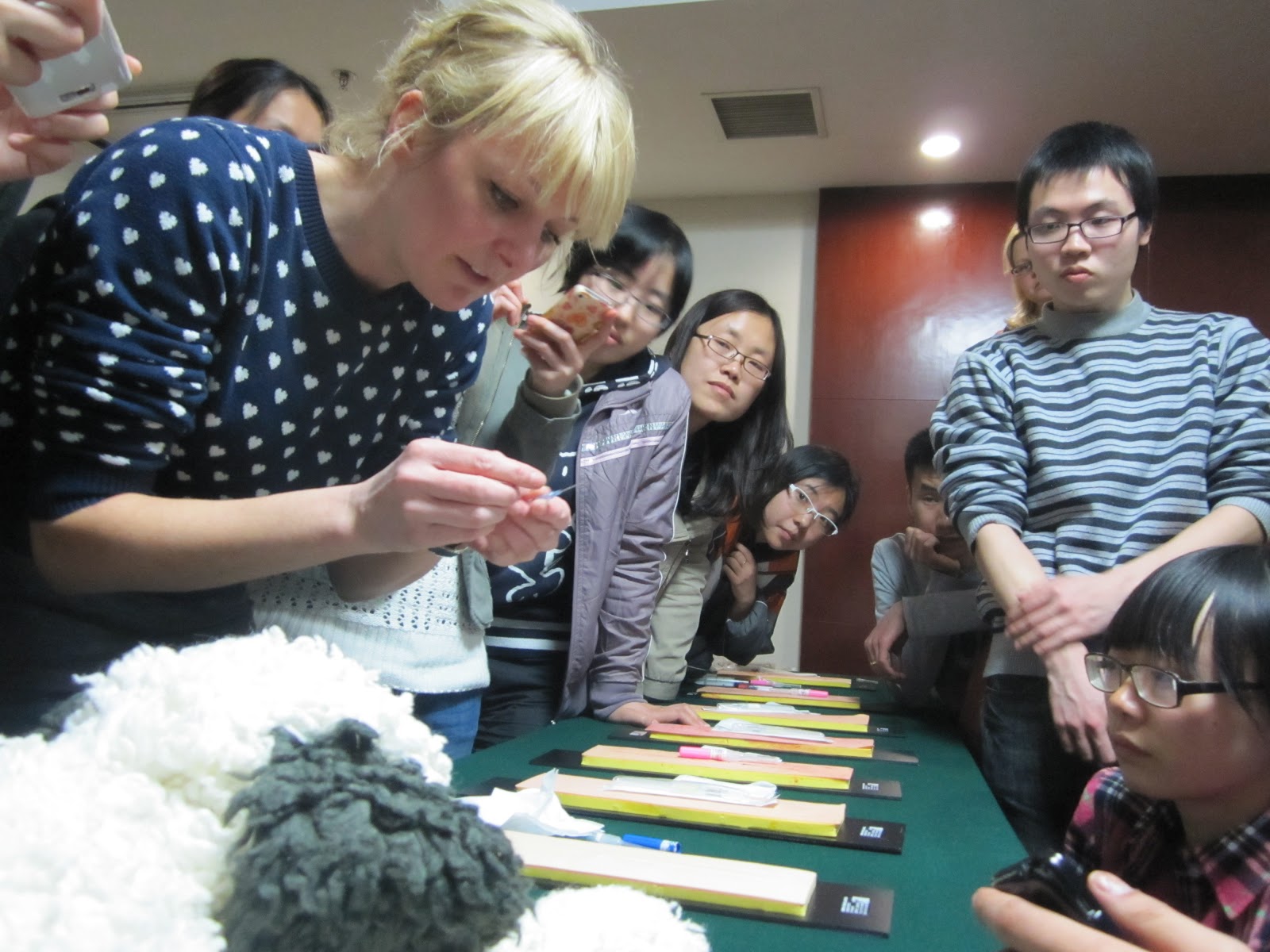
The week began with a series of lectures in surgical techniques, anaesthesia, analgesia, patient care, street dog population management, shelter management, ethics and welfare and then progressed to practical, hands on clinical skills workshop. During this time the students were able to use models and manikins to practise their clinical skills on such as suturing, ligature tying, IV cannula placement and intubation under the guidance of staff from JMICAWE and Animals Asia. This offered the students the time to learn and perfect their techniques before going near a live animal.

Qualified veterinary staff instructed and demonstrated techniques to acquaint students with the various clinical processes, and then the supervised students took on the roles of anaesthetist, surgeon and in-patient carer, following their patients through the different clinical processes. This practical, reality-based training is completely different from the usual approach to veterinary clinical training in China, where dogs are purchased by universities and used by the students to practise a range of unnecessary surgical procedures, without appropriate analgesia.

The student’s reaction to the course was extremely positive and the JMICAWE team were pleased with the obvious improvement in students’ skills and knowledge.

“It’s important to remember that training workshops or TNR programmes must never just be about teaching surgical skills, or controlling a population.” said Hayley Walters of the JMICAWE. “Each of the patients is a sentient being that is feeling scared, anxious, confused and lonely. Each patient is capable of feeling pain, suffering from inadequate anaesthesia and, worse still, death due to poor surgical technique and a lack of knowledge or experience.  Whilst teaching the students we were very keen to ensure that they not only learned about surgical procedures but that the welfare of the animal goes hand in hand with this.”


Delivering Animal Welfare Education as part of the WSPA Key Driver Programme in Taiwan

The JMICAWE’s Professor Nat Waran is returning from Taipei after being invited by WSPA to attend their 'key drivers' conference. The Annual World Society for the Protection of Animals (WSPA) meeting was sponsored by the Taiwanese Governments NGO Affairs committee, Taipei City Animal Protection Office and the Life, Welfare and Environmental Quality Association, and took place over two days at the start of May.

Professor Waran gave presentations on how to provide 'training in the scientific and practical assessment of animal welfare' and also how to 'use problem based learning for delivering animal welfare education to veterinary students in Asia'.

The conference was attended by academics from vet schools in Vietnam, India, the Philippines, Taiwan, Thailand, Malaysia, China and South Korea.

During the conference, 15 academics working as ‘key drivers’ for animal welfare education within their vet schools were gathered to discover and discuss approaches to teaching animal welfare, new information about animal welfare science & ethics and continuing professional development (CPD) for veterinarians.

The opportunity to share best practice and experiences as well as discussing the use of innovative teaching and research tools was extremely valuable for all attendees, and will go a long way towards developing animal welfare awareness amongst the veterinary profession in Asia.


Thursday, 25 April 2013

International collaboration promotes Animal Welfare through Veterinary Education, in China

Society increasingly expects veterinarians to ensure that animals used for food, companionship or research are healthy and managed humanely. It is understood that international standards of animal welfare are vital to public health, animal disease management and the economic role of animals in society, and this requires dynamic and progressive teaching techniques.

To this end, the JMICAWE in partnership with Animal Asia and Nanjing Agricultural University delivered a three day conference for academics from leading Veterinary Universities across China. The conference highlighted the need for skills in critical thinking and evidence-based veterinary medicine, and utilised creative, problem-based teaching techniques to engage lecturers. We also shared international standards of best practice in veterinary education and promoted the integration of new innovative approaches and technologies into veterinary teaching.

By encouraging the development of analytical skills and creative solutions to current animal welfare issues in veterinary education, JMICAWE aims to highlight the international importance of animal welfare in the veterinary curriculum, and promote integrated themes of practical animal welfare, and appropriate animal use in veterinary teaching.

Following on from this meeting, students from the NAU had the unique opportunity to experience international training in surgery, anaesthesia and dog population management delivered by veterinary experts from the JMICAWE and Animals Asia through a collaborative programme with the Nanjing Public Security Bureau (Nanjing PSB).

It is hoped that this collaborative programme will continue to promote practical training in key analytical, problem-solving and advanced clinical veterinary skills in the future, resulting in veterinarians being better equipped to work in an increasingly global profession.


Wednesday, 24 April 2013

Improving links between India and Edinburgh

Professor Nat Waran is excited to be travelling to Kochi today, to attend the International VetEd Conference which is focusing on Developing and Embedding a Problem Based Learning Approach in Veterinary Curriculums. The Conference is held in Kochin on 26 and 27 April 2013, and is a collaborative effort between the University of Edinburgh and the Kerala Veterinary and Animal Sciences University (KVASU).
Professor Waran, from the JMICAWE will be giving presentations on ‘Future proofing veterinary education’ and also another one on ‘The use of animals in teaching and research’ to the delegates of the conference, which include many Deans and Professors from 18 Veterinary Colleges within India.
For those who wish to attend please email veteducon@gmail.com or visit www.kvasu.ac.in.
The University of Edinburgh are also delighted that Professor Waran will be available to meet Dr Ashok, the KVASU Vice Chancellor, to sign the Memorandum of Understanding (MoU) Agreement, which has come about after a year long programme of work funded through the British Council’s Higher Education Knowledge Partnership scheme, to help build collaborative relationships between UK and Indian universities. This MoU is a continuation of this one year long project – which is to develop further areas of collaboration including production animal health and welfare, teaching early clinical skills using animal alternatives and computer based learning tools and developing links with wildlife medicine and management.
Animal Welfare Science and Conservation Medicine teaching and research are strength areas for the University of Edinburgh’s Royal (Dick) School of Veterinary Studies. For example, The Jeanne Marchig International Centre for Animal Welfare Education, under the directorship of Professor Nat Waran, is a unique facility which is described as a hub of expertise on animal welfare education, collaborating with international partners to advance understanding of animal welfare issues, and has an important role in improving the quality of life for animals through providing information and guidance on education and training in relation to animal welfare, for up-skilling the veterinary profession. Whilst The Exotic Animal and Wildlife Centre, under the leadership of Dr Anna Meredith is a Centre of expertise on conservation medicine and wildlife health and welfare.  
It is hoped that this MoU will provide both parties with opportunities for student and staff exchange for research and teaching and to help develop expertise in these areas in Kerala.
Further information on both the JMICAWE and Wildlife & Conservation Medicine are available on www.ed.ac.uk/vet .


Monday, 15 April 2013

KVASU to sign pact with University of Edinburgh - The Hindu

Following on from three very successful workshops in Kerala, the Kerala Veterinary and Animal Sciences University (KVASU) will sign an MOU with the University of Edinburgh, U.K., on wildlife studies.

As part of the pact the KVASU in collaboration with the University of Edinburgh (UoE) and the British Council India will organise an international workshop in Kochi from April 26 to April 27 to promote problem-based learning approach in veterinary science in the country.

Problem-based learning (PBL) was emerging as one of the important areas of learning, said T.P. Sethumadhavan of Directorate of Entrepreneurship, KVASU. The university would play a proactive role in promoting this concept, he said. Around 40 delegates comprising vice-chancellors and deans of various veterinary universities in the country will attend the workshop.

As a part of the collaborative programme with the Jeanne Marching International Centre for Animal Welfare Education (JMICAWE) at the University of Edinburgh, the KVASU, will act as a facilitator for implementing problem based learning in the country, which will be one of the initial ventures in this sector.

Professor Natalie Waran, Director of Jeanne Marching International Centre for Animal Welfare Education at the Royal (Dick) School of Veterinary studies of University of Edinburgh, is the project coordinator.


Latest veterinary techniques set to spread through China

Academics responsible for training China’s vets have been armed with the latest technologies and techniques at an educational workshop held this week at China’s Nanjing Agricultural University.

The workshop is part of an ongoing programme of events that have been put together by the University of Edinburgh and Animals Asia. The workshop was held in partnership with Nanjing Agricultural University, the Chinese Veterinary Medical Association and the Nanjing Public Security Bureau.

The Jeanne Marchig International Centre for Animal Welfare Education (JMICAWE) of the University of Edinburgh, is a hub of expertise on animal welfare science in education and research, collaborating with international partners to advance understanding of animal welfare issues. Animals Asia is an animal welfare organisation working to improve the welfare of animals in China and Vietnam.

The event will share international standards of best practice in veterinary education and promote the integration of innovative new approaches and technologies into veterinary teaching.

Following the event, a second workshop aimed at veterinary students at the Nanjing Agricultural University will provide training in surgery, anaesthesia and dog population management by veterinary experts from the University of Edinburgh and Animals Asia through a collaborative programme with the Nanjing Public Security Bureau.

This forum will promote practical training in key analytical, problem-solving and advanced clinical veterinary skills, helping to better equip veterinarians with the skills needed to work in an increasingly global profession and to deal practically with welfare issues such as rabies and dog population management without resorting to inhumane or ineffective practices.

Heather Bacon of the Jeanne Marchig International Centre for Animal Welfare Education (JMICAWE) of the University of Edinburgh commented:
“Society increasingly expects veterinarians to ensure that animals used for food, companionship or research are healthy and managed humanely. It is understood that international standards of animal welfare are vital to public health, animal disease management and the economic role of animals in society. The public expects the veterinary profession to take a leading role in promoting respect for animals in a harmonious society.”


http://www.animalsasia.org/index.php?UID=9EIQ8TMW5WZ

China-Edinburgh link to boost veterinary care and animal welfare

The role that vets in China can play in safeguarding animal welfare will be strengthened by an agreement enhancing the country's veterinary training.

The University of Edinburgh has signed an agreement with the Chinese Veterinary Medical Association (CVMA) that will see both parties collaborate on innovative veterinary research and educational programmes.

The agreement - the first between the CVMA and a UK university - will also seek to promote and strengthen the role of the vet in China, particularly in the area of animal welfare.

Prof Natalie Waran, Jeanne Marchig Professor of Animal Welfare Education at the University of Edinburgh, said: "This historic agreement, which draws upon the University of Edinburgh's expertise in animal health and welfare research, will promote and support the development of continuing veterinary education in China.

"Along with the CVMA, we hope to develop dynamic educational expertise to enhance veterinary education - not only training Chinese veterinarians to meet the challenges of a changing and globalised profession, but also promoting animal welfare in the veterinary curriculum to ensure public safety and reduce epidemics."

The agreement forms part of a collaboration between the CVMA and the Jeanne Marchig International Centre for Animal Welfare Education, which opened in 2011 and is part of the University of Edinburgh's Royal (Dick) School of Veterinary Studies.

The collaboration also aims to promote and support innovation in postgraduate veterinary education in China. It will also draw upon expertise in international animal welfare from the Jeanne Marchig International Centre for Animal Welfare.

The centre's researchers collaborate with international partners to advance understanding of animal welfare issues, and aim to facilitate the highest standards of animal welfare training through collaboration with professional bodies and other academic institutions around the world.


http://www.ed.ac.uk/news/2013/chinavet-041013 

Thursday, 11 April 2013

The Brooke Animal Charity gains new Trustee

It is with pleasure that we can announce that Natalie Waran, Director of the JMICAWE has been appointed as a Trustee of the Brooke Animal Charity.

The Brooke's vision is of a world in which working horses, donkeys and mules are free from suffering. They work towards this through direct veterinary treatment, community programmes around animal health and well-being, research and education.

The veterinary approach is based on supporting the provision of preventative and treatment services to working horses and donkeys, both in the short-term and long-term. They promote the importance of an evidence based approach,  and they are keen to ensure that improvements to the welfare of working equids are based on the best available qualitative and quantitative evidence. They focus their longer term work on community development and they apply learning methods that have been used successfully in a human health and development context.


Wednesday, 10 April 2013

Surgical Dog Sterilisation Skills Training in Bosnia

A recent survey has estimated there are in excess of 11,000 stray dogs in the City of Sarajevo alone. Surgical sterilisation is important for the welfare of individual owned dogs and as key part of dog population management. There is also an increasing demand for surgical sterilisation as more owners recognise the health benefits of neutering and see it as a key part of responsible dog ownership. This course run in partnership between the Veterinary Faculty, Sarajevo, and Dogs Trust BH aims to give participants the practical skills they need to be able to competently and confidently neuter dogs independently. The course has three aims:
  • The first is to up skill Veterinary Surgeons, giving them practical surgical skills to neuter a dog, which also provides transferable skills that the surgeon can apply to other procedures eg exploratory laparotomy
  • The second is to understand the welfare around the care of patients before, during and after surgery and in becoming confident in the use of General Anesthetics available in Bosnia-Herzegovina
  • The third is to develop an understanding of the veterinary profession’s role in responsible dog ownership and dog population management
The seven-day course is highly practical with tutorials on key topics and it is taught by a combination of Bosnian and British veterinary surgeons. Congratulations to Hayley Walters, one of the JMICAWE team and an anesthesia nurse at The Dick Vet Hospital who went out for 2 of the courses, to help establish the training clinics and assist the Dogs Trust teams, so that they are now confident to go on and train more Bosnia vets with these clinical skills.
Fore more information, please visit Dogs Trust website or email ApplicationVFSDT@gmail.com.

Tuesday, 9 April 2013

ISES Conference 2013

"Embracing Science to Enhance Equine Welfare and Horse-Human Interactions"

International Society for Equitation Science, 9th Annual Conference

The University of Delaware, Newark, DELAWARE. USA

18th, 19th & 20th July 2013

The International Society for Equitation Science (ISES) announces the 9th annual conference with the theme of "Embracing Science to Enhance Equine Welfare and Horse-Human Interactions" to be hosted jointly by the University of Delaware and the University of Pennsylvania, United States of America on the 18th – 20th July, 2013.
This premier event will allow over 200 equine scientists, veterinarians, applied ethologists, advanced practitioners (horse-trainers, instructors & riders), advanced students pursuing equine science degrees and influential stakeholders in the equine industry to come together to present and discuss research related to the field of equitation science. It will focus on ways of improving horse training as well as encouraging the development of science-based criteria to measure the welfare of the horse in its interactions with humans.

The conference will be opened by Camie Heleski, PhD, who is a leading expert in Equitation Science and Instructor and Coordinator of the 2-year Ag Tech Horse Management Program at Michigan State University. Heleski has been involved with ISES from its conception in 2005 to ISES becoming an official society in 2007; continuing to serve as an ISES Council Officer and in the role of Co-chair for this year’s conference. Heleski has conducted work in learning theory with both horses and donkeys and is passionate about her work specializing in working equids in developing parts of the world. "Our overarching theme for the 2013 ISES conference is ‘Embracing science to enhance horse-human interactions’. I am especially excited about one of our sub-themes ‘getting the message out about equitation science and learning theory’ – in other words, how can we capitalize on outreach and education methods to inform people about the value and importance of equitation science. Whilst conducting the research is extremely important, we must also make sure we get information to the stake holders at the front line of the horse industry". – Camie Heleski, PhD.

Keynote speakers for the 9th International Society for Equitation Science Conference include:
 Professor Hilary Clayton - Research on the Rider-Saddle-Horse Interface
 Professor Jan Ladewig - What about the other 23 hours? How does what we do during the other hours when we are not training impact behavior and welfare?
 Andrew McLean, PhD & Professor Paul McGreevy - Arousal, affective state and attachment

Practical demonstrations will take place during the 2013 ISES Conference Practical Day which will be held at the New Bolton Center, University of Pennsylvania. Themes for the Practical Day include:
 Is it Physical? Psychological? Or both?
 Development of the Equid Ethogram
 Applied Learning Theory
 Fair Training Practices in Action

Professor Sue McDonnell is a Certified Applied Animal Behaviorist and Head of the Equine Behavior Program at the University of Pennsylvania, New Bolton Center. McDonnell will deliver a presentation on the development of the equid ethogram and host a tour of the semi-feral pony herd; Angelo Telatin is an Assistant Professor at Delaware Valley College. Telatin will demonstrate how riding and handling horses can be enhanced when integrated with the knowledge of learning theory, by jumping a horse bridleless and showing how tasks such as clipping and giving a horse injections can be simplified by giving the horse a choice to perform a desired behavior.

Throughout the ISES Conference delegates will have ample opportunities to:
 Connect and network with ISES members during breaks, poster discussions and dinners in order to exchange ideas and foster research cooperation;
 Seek guidance with the application of the principles and practices of equitation science for individuals own equestrian practices;
 Attend clinics conducted by equine behaviorists and practicioners demonstrating practical equitation that is in line with scientific principles of training and learning;
 Discuss strategies to enhance the cooperation between scientists, animal welfare activists and equestrian riders, trainers, coaches, industry and government representatives and international leaders in sport across the sector.

Email: ISESconference2013@equitationscience.com

ISESconference2013@equitationscience.com

http://www.equitationscience.com/upcoming

Wednesday, 3 April 2013

Our inspirational trip to Animals Asia' s Centre in Chengdu

A blog by 2 of our MSc AABAW graduates - thanks to Jessa & Faye

Our two months in China was an extremely unique experience that we are so glad to have had the opportunity of. Not only were we able to do our own original behavioural research, we also spent time in the wonderful company of the staff and the bears at the Animals Asia Moon Bear Rescue Centre in Chengdu- amazing people and animals.
We learnt of the bear`s horrible pasts in the bear bile farm industry and saw with our own eyes not only the scars from their suffering, but also the remarkable improvement and recovery they achieved, both physically and mentally, at the sanctuary – a sight that can`t but make you smile through the tears, to see these tortured bears so well recovered and happy – playing with each other, splashing in the water and sleeping peacefully, never again to suffer as they did in the past. We experienced first-hand the daily routine of vets and bear house managers in providing the animals with not only health care, food and water, but also an ever changing, always stimulating schedule of environmental enrichment.
The bears are stimulated to actively forage and engage with their environment and fellow bears, rehabilitating body and mind from the confinement and boredom they experienced for years, sometimes decades. For us, it was inspirational and rewarding work, knowing these tortured bears have nothing else to fear for the rest of their days. We can now only do our best in supporting Animals Asia in their quest to free more of the 10,000 moon bears currently in bile farms in China, by raising awareness about the bile farming practice and inspiring donations to the foundation. We mourn every rescued bear that dies at the centre and ask them to “please look upon the others, give them promise of hope soon, and tell them to be patient and proudly wear the moon”.


Tuesday, 2 April 2013

Welfare standards of food served in The University of Edinburgh’s Canteens

A Blog Posting from student – Mary Baxter
Listening to Sean Wensley give his talk on ‘The Vets Role in Improving Animal Welfare’ was one of those brilliant moments where he might as well have been describing my feelings going into the veterinary world.
The focus on economics and productivity, and the repeated presence of oxymorons such as the ‘problem of broodiness’, bothered me throughout my undergrad. Sean highlighted the self-confessed gap of many vets in their ability to accurately assess or understand animal welfare, and that inaction when presented with potentially welfare damaging scenarios, such as sending an animal to a slaughter house where it will not be stunned, is often interpreted as tacit acceptance.
In the question and answer session following the lecture, conversation turned to the consumer’s role in choosing higher welfare food and how, in a talk Sean had given, the students were very keen not to source pizza containing meat that may have come from an animal that had not been stunned. I realised that, as an Edinburgh University student, I had no idea about the provenance of the food served in the University’s canteen.
But, surely, as Edinburgh is so well known for its welfare education, the food served here would be from the highest possible sources? I decided to find out and began emailing people I hoped would be able to point me in the right direction. I got in touch with the kitchens manager, assistant director of catering at Edinburgh and Campbell Brothers (who supply meat to the University) to find out the welfare standards of the food offered. Everyone was very helpful and I was able to establish that all eggs are free range and the meat provided is produced under the Red Tractor Assurance Scheme. When I asked if there were any plans to improve these standards, as the Red Tractor Scheme holds the lowest welfare standards above legal minimums, it was confirmed that there are currently no plans to source meat from higher welfare farms. The reasons given were a mix of economics, the University’s reluctance to support one lobbying group (i.e. Soil Association) and the bafflingly complicated world of contracting authorities and the legal block on discriminating against one meat supplier over another on grounds of higher welfare.
Edinburgh University has already made giant leaps in meat and animal product procurement and is the only University to have been awarded a Bronze Food for Life Catering Mark. As a forerunner in welfare education and with over 19,000 undergraduate students alone, Edinburgh University represents a huge consumer force. As part of that consumer force, we have a unique opportunity to pull together and initiate change. The change may take a long time to push through, but registering our interest in higher welfare food at the University, and steering clear of a perceived tacit acceptance, is the first step in setting all the cogs in motion.