Monday, 9 November 2015

Improving welfare in Vietnamese Veterinary Education


Last week Heather of the JMICAWE made a return visit to the Hanoi National University of Agriculture, a longterm collaborator with the JMICAWE.  Heather first visited the University in 2012 to co-deliver a National workshop on Veterinary Education alongside Professor Natalie Waran and RVN Hayley Walters of the JMICAWE, and funded by Animals Asia. Since them she’s also visited to discuss curriculum reviews and the use of animals in education.  This visit included discussion of ongoing animal welfare research at the university on different housing systems for pigs, and delivery of Animal welfare lectures to over 200 veterinary and animal science students. Heather also met with lecturers who are currently proposing a curriculum review and wanting to move away from traditional didactic learning to more innovative methods, including, where possible, phasing out the use of animals in teaching.

Speaking from Vietnam Heather said “It’s been really exciting to see the developments at HNAU over the past few years. The progressive and collaborative approach of the staff here mean that effective animal welfare education is a reality for many Vietnamese veterinary and animal science students, and I look forward to the proposed changes and future research and educational collaborations


Rare native breed ‘Dragon’ Chickens so called for their large feet at HNAU

Heather with students at HNAU


Thursday, 5 November 2015

What's The Impact of a MOOC?

Our Animal Behaviour and Welfare MOOC has been running in it's new 'on-demand' format for a little under a week now and a whole new set of students are getting a chance to learn about animal behaviour and welfare, but does that learning actually make a difference?

We were lucky enough today to be visited by one of our MOOC students, Hilda Hermann. Hilda is the Project Coordinator for Outreach KZN, an animal sterilisation and vaccination project in South Africa. In the three and a half years that Hilda has been working with the project, they've sterilised over 27 000 animals.

Many of the staff at Outreach KZN took part in the MOOC and Hilda gave us lots of valuable feedback about what worked in the course, what was difficult, and what people would like to see more of.

But our favourite part was hearing how useful the staff found the MOOC. Working in rural parts of South Africa it can be difficult finding educational resources that fit into busy working lives and schedules, and we think the new on-demand MOOC will be an even greater help in getting the animal welfare message out there at a time and in a format that suits learners.

We also loved this picture of the animal care staff at Outreach KZN with their certificates - it certainly made our week hearing about the impact the course has had!


If you'd like to take the course you can sign up via Coursera by clicking here. You can share your stories about the MOOC in the comments, or on Twitter by tweeting us @JMICAWE or using the #EdAniWelf hashtag. 

Monday, 2 November 2015

Animal Behaviour and Welfare MOOC - Now On Demand

We are really excited to announce that the Animal Behaviour and Welfare MOOC from Coursera is now live and on demand.

You can join the course by clicking on this link and signing in or registering with Coursera.

Nat, Fanta and our cameraman Tim preparing a lecture

What is an on-demand course? 
On-Demand courses can be accessed at any time, and you can take as long as you need to finish the materials and earn your certificate. This means that you'll be able to view the lectures and engage with your fellow students forever.

Could I used the materials to teach with?
Yes! We would be more than happy for you to point your students towards the course or to download the videos and use them yourself to teach animal welfare. All we ask is that you don't change the materials (so don't edit the videos or take our name off them).

Can I still get a certificate?
The On-Demand courses only offer the Verified Certificate, which is a paid certificate. When you start a quiz, Coursera will ask you to verify your identity using a webcam and your typing speed. If you want to earn a certificate, you will need to verify your identity at the start of each quiz.

Why did you do away with the free certificate?
Unfortunately this was Coursera's decision. There  is financial aid available through Coursera for the Verified Certificates.

Will you still be on the forums and run Hangouts?
We have a number of postgraduate students helping us out on the forums and we'll be there too, but on-demand courses are designed to be more independent. We are planning on running Hangouts when there is a demand for them.

How successful was the old session-based course?
We were absolutely delighted with the session-based courses. Over the two sessions we ran over 50,000 people signed up with 37,279 students watching at least some of the lectures. We awarded 9029 certificates of completion. Over 27% of our students came from emerging economies and 66% held an undergraduate degree or higher


So come along and join in, you can tweet us @JMICAWE or use the #EdAniWelf hashtag.

We'll see you there!


Sunday, 25 October 2015

International Companion Animal welfare Conference promotes the need for an evidence based approach


This month, the JMICAWE was delighted to be invited to present at the annual International Conference on Companion Animal Welfare, Hosted by the Dog’s trust in Porto, Portugal.

The conference showcased the work being done around the world to improve dog and cat welfare by organisations such as Dog’s Trust, IFAW, Mission Rabies, Nowzad, and Change for Animals Foundation, as well as including presentations from Rachel Casey of the University of Bristol and our own Heather Bacon of the JMICAWE.

Speaking at the conference Heather said;

This is a great opportunity to engage with stakeholders working in all aspects of dog and cat welfare – from TNR projects to shelters to pet dogs and cats, the ubiquitous nature of our companion animals means that we often rely on tradition or assumptions to manage them, but conferences like this promote the communication of evidence-based approaches to dealing with thorny issues such as overpopulation, rehoming, or behavioural problems.”

Heather’s presentation – on the evaluation of dog welfare in TNR projects highlighted the importance of the individual, even in large scale population control effort. She presented the results of work carried out by the JMICAWE team in India and Africa, funded by the Dogs Trust,  to develop a method for assessing the welfare of the individual animal before, during and after experiencing a 'Trap, Neuter and Return' programme.  

The conference also included the second annual meeting of the EU Dog and Cat alliance – a multidisciplinary group working on dog and cat relevant health and welfare issues across the EU http://www.dogandcatwelfare.eu/

Thursday, 22 October 2015

Animal Welfare Masters students visit the Highland Wildlife Park


This year's MSc Applied Animal Behaviour and Welfare students enjoying a visit to the RZSS's Highland Wildlife Park.


This year we welcomed 38 Postgraduate students from various parts of the world, to study on the on-campus Masters programme in Applied animal behaviour and welfare.  As part of their studies, the students recently enjoyed a visit to the Highland Wildlife Park (RZSS)in Aviemore, where they got the chance to carry out animal welfare assessments on certain enclosures and then discuss their findings with the HWP staff. The HWP keepers and management were very interested to hear the comments and suggestions made by our students, and promised to consider them as part of their regular animal welfare audits. The University of Edinburgh and the RZSS have had a long and productive relationship, and regularly work together to develop and deliver high quality education and research to enhance captive animal health and welfare. The visit to the HWP provided these international students to learn more about the conservation work being carried out there to benefit native Scottish Species, as well as to showcase the beauty of the Scottish Highlands. What a great way to learn!


Tuesday, 20 October 2015

New Video: Dog Welfare in Trap-Neuter-Return Programmes

We're very excited to announce the launch of our new video on YouTube, created in partnership with the Dog's Trust.

The Dog's Trust awarded the JMICAWE a grant to investigate dog welfare in Trap-Neuter-Return (TNR) programmes. This method is advocated by animal welfare organisations and the World Organisation for Animal Health (OIE). However, with high targets for the TNR programmes in many countries, we need to ensure that we are not putting individual dog welfare at risk in order to achieve population control.

In this video, Heather Bacon, our Veterinary Welfare Education and Outreach manager talks about some of the work we've been doing with the Dog's Trust to understand and measure welfare in a TNR programme.


As Heather says, dog population management is a global issue. A good TNR programme will protect dog populations by improving their health, their relationships with the human community and controlling their population size. But a good TNR programme also needs to consider the use of welfare measures to monitor dog welfare while they are going through the programme.

Edinburgh Veterinary Nurses share Animal Welfare expertise in India

 
Animal welfare experts and veterinary nurse students are travelling to India to help raise standards of care for sick animals. They will share knowledge and demonstrate clinical techniques and interventions that can significantly improve animals’ quality of life.
 
Animal Welfare experts from the University of Edinburgh’s Jeanne Marchig International Centre for Animal Welfare Education will be joined by students from Edinburgh Napier University on the 10-day trip to work with colleagues at the Kerala Veterinary and Animal Sciences University. This builds on the four year relationship that has been developed between Edinburgh and Kerala to support staff capacity building in teaching animal health and welfare.

Veterinary Nursing and Animal Welfare

Developments within veterinary training institutes across the world have often concentrated on investments in technologically advanced equipment and training of veterinary surgeons. However, good welfare of hospitalised animals starts before the consultation room and long after medical or surgical intervention; this is the domain of the veterinary nurse. Through this project we hope to raise awareness of the vital role of veterinary nurses in improving care for animals that require medical attention. Currently there is no official recognised veterinary nurse training scheme or qualification in India, despite the country’s booming pet population. The Edinburgh team of vets, veterinary nurses and animal welfare scientists will work with colleagues in Kerala to provide training in animal nursing care and will demonstrate how vets and veterinary nurses should work side by side to provide for the health and welfare needs of animals through the whole veterinary experience.
An animal’s experience can be improved dramatically when nursing care is provided by a knowledgeable, well trained and compassionate individual. Veterinary nurses are in the perfect position to do this.
Hayley Walters
Welfare Veterinary Nurse, Jeanne Marchig International Centre for Animal Welfare Education

Best practice

They will also share best practices in hygiene and infection control and explain how to recognise and manage pain in animals. In return, the Edinburgh students will benefit from being exposed to veterinary practices in a different environment, tackling problems they may not have encountered elsewhere.
We are excited to have the opportunity to learn from our colleagues in India and to experience caring for animals in an environment that brings challenges we haven’t faced before.
Natalie Maxwell
Veterinary Nursing student, Edinburgh Napier University

Animal Welfare Education

Kerala Veterinary and Animal Sciences University is one of India’s well respected veterinary universities. It delivers annual workshops on animal welfare teaching in conjunction with the University of Edinburgh. The visit and workshop will take place in November 2015. The students, who have begun fundraising for the trip, will track their experiences through a blog. So watch this space.

Wednesday, 14 October 2015

Animal Welfare a priority for European zoos

EAZA Poland 2015


Last month Heather Bacon of the JMICAWE was in Wroclaw, Poland to deliver key training on zoo animal welfare at the annual conference of the European Association of Zoos and Aquaria.

Attended by 700 representatives from zoos as far away as China, the USA and Russia, the annual EAZA conference is able impact globally on the understanding of key zoo animal welfare issues.

During the conference Heather was involved in delivering two workshops and a plenary presentation on various aspects of zoo animal welfare. Additionally EAZA has announced the formation of a new Animal Welfare Working Group to specifically address questions from members about animal welfare.

Speaking from Wroclaw, Heather said “It is extremely positive that EAZA – an organisation with 293 zoo members, is focussing on developing capacity in animal welfare. This positive engagement is a crucial step in promoting good welfare for zoo animals throughout Europe and beyond. Whilst zoos may be  ethically controversial, it is important to engage with the zoo community in the same way that we engage with farmers, veterinarians and researchers, to promote effective education, and good standards of animal welfare, across all communities.”

Wednesday, 7 October 2015

From Edinburgh to Japan; Animal Welfare takes Centre Stage


Last month, Professor and Centre Director of JMICAWE, Nat Waran gave a plenary talk at the ISAE conference in Hokkaido on Companion animal welfare conundrums, as well as providing a talk on 'Going Glocal' to solve animal welfare issues.


ISAE September 2015


The International Society for Applied Ethology (ISAE), celebrates its 50th Anniversary in Edinburgh next year, when we are expecting more than 500 animal behaviour and welfare scientists to be in attendance. 
 

The Japan trip didn't end there.
 
Japan's population of pets is growing rapidly and with international concerns for animal welfare rising, Japanese researchers, veterinarians and government officials are keen to learn more about why animal welfare matters in countries elsewhere. Centre director, Prof Nat Waran and SRUCs Dr Fritha Langford, were invited speakers in Tokyo, where they provided talks at Tokyo and Teikyo Universities as well as during a workshop on "why animal welfare matters" .
 

Wednesday, 30 September 2015

Raising the issue of live animal use in veterinary education to a global scale


This month saw our welfare veterinary nurse, Hayley Walters, attend her second BSAVA (British Small Animal Veterinary Association) International Affairs Committee meeting. Held in Birmingham three times a year, Hayley is the first veterinary nurse to sit on the committee. The International Affairs Committee is responsible for links within the Union of European Veterinary Practitioners (UEVP) and the Federation of Veterinarians of Europe (FVE) as well as liaising with the Federation of European Companion Animal Veterinary Association (FECAVA) and the World Small Animal Veterinary Association (WSAVA) This committee allows BSAVA to identify and influence matters of importance to the small animal veterinary surgeon in Europe and further afield.
Sheep used for suturing practise at a vet school in China


JMICAWE’s Heather Bacon teaching suturing on a suture board
Hayley presented a report written by herself and colleague Heather Bacon, highlighting the use of live animals in veterinary education in vet schools in developing countries and how this is not only harmful to the animals used for clinical and surgical skills practise but also detrimental to the quality of education that the student receives. Veterinary students often feel conflicted when faced with having to perform unnecessary surgery on an animal in the name of their education. The report also highlighted research carried out showing that veterinary students lose empathy for animals as they progress through vet school and objectifying animals is necessary for them to be able to continue with their practical training. Vets have to be ambassadors for animal welfare so it is of the utmost importance that they leave vet school compassionate, empathetic and dedicated to improving the lives of the animals under their care.

Everyone attending the meeting agreed that countries still teaching students in this manner needed to align with international standards of education and a unanimous decision was made to present the report to BSAVA’s scientific committee. Once the report has been approved it will receive BSAVA’s full endorsement and ultimately be sent to WSAVA. WSAVA is a global veterinary community set up to facilitate the exchange of scientific information between individual veterinarians and veterinary organisations all over the world.

JMICAWE made several recommendations in the report, including how to phase out the harmful use of live animals in veterinary education, and it is hoped that with WSAVA’s endorsement to its worldwide contacts, more vet schools will look to make the change.


Wednesday, 23 September 2015

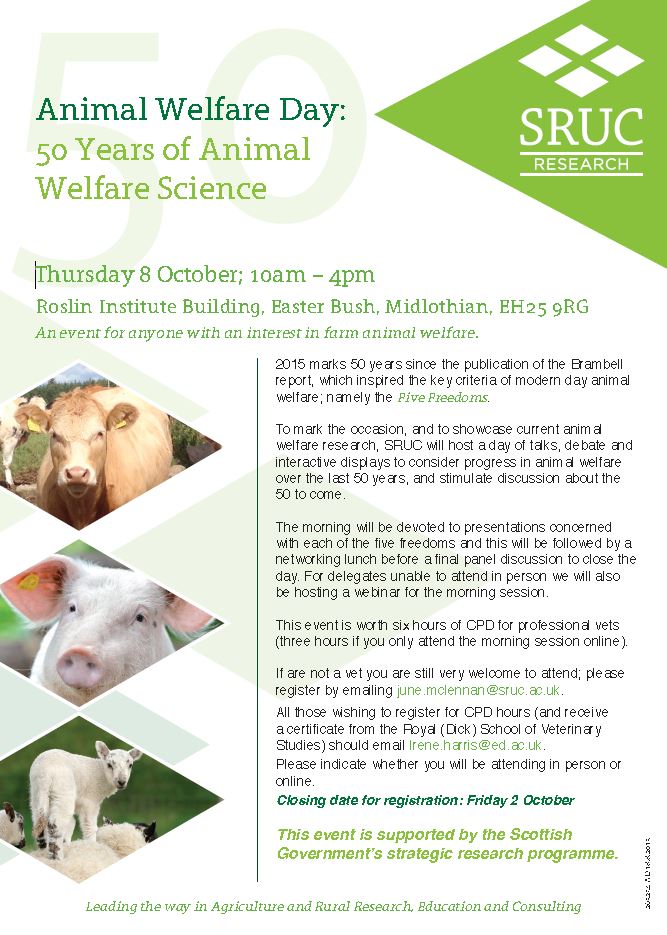
Animal Welfare Day 8th October in Edinburgh


Scientists from Scotland’s Rural College are inviting secondary school children from across Scotland to join them for a virtual discussion on how best to care for our animals. The animal welfare experts will be online on Friday 2 October at 1pm and school classes can join them by using Google+ Hangout or through YouTube.
Hangout organiser Dr Jill MacKay explains: “Animal welfare is now a part of the higher biology curriculum so this is a great chance for students to discuss the key issues such as disease, hunger and distress with scientists at the forefront of animal welfare research. Students can email or tweet questions in advance and then watch our researchers answer them on a live feed.”
The event has been organised to celebrate 50 years since a significant report on livestock welfare which highlighted need for scientific methods of assessing animal welfare and called for better more consistent care. As the report is a foundation stone of modern day animal welfare research, the scientists will also discuss the journey from that publication to modern day animal welfare science and what lies in store in the years ahead.
Students or teachers who want to join the hang out or find out more should email jill.mackay@sruc.ac.uk. They can also send her questions for the scientists or tweet them to @SRUCResearch using the #Freedoms50 hashtag.
 
G+ Event Page: https://goo.gl/kIYIuz
YouTube Direct Link: http://goo.gl/01IZXs


Friday, 18 September 2015

Edinburgh Animal Welfare Students Shine at Behaviour and Welfare Conference in Japan


It's always good to see former students flying the best and contributing so positively to their field.  This week we bumped into several at the ISAE 2015 Conference in Japan!


Jessica Lampe, former Masters applied animal behaviour and welfare presenting her poster at ISAE 2015 Japan 

This week in Hokkaido we saw a number of ex Edinburgh Masters students presenting their animal welfare work to a big International audience. Some examples were: Dr Jenna Kiddie talked on Enrichment needs for long term kennelled rescue dogs in the Philippines, Dr Poppy Statham described her work on positive emotions in pigs, Dr Maria Diez Leon discussed the issues for mink in farms, Dr Jo Edgar spoke of chick stress responses, Dr Jessica Lampe showed us her work on enhancing Lab rat welfare through positive handling, Dr Simon Turner explained how breeding may help reduced pig aggression and Dr Yoshie Kakuma of Japan and her students presented their work on improving pet welfare in Japan. 

We are really proud of the part we played in the early careers of these researchers, who are contributing to evidence based animal welfare improvements all over the world and on a wide range of species! 


Wednesday, 16 September 2015

Virtual Animal Welfare Discussion between Edinburgh and 8 Asian Country representatives


This week, JMICAWE Director, Prof Nat Waran, took part in a live online discussion with animal welfare lecturers working in various parts of Asia, who were attending a workshop hosted by the World Animal Protection.

The 4 day annual workshop held in Bangkok, brought together key drivers for animal welfare education, from veterinary schools in a range of countries, including; Vietnam, the Philippines, Malaysia, Indonesia, India, China and Taiwan. Using Skype, Prof Nat was able to pose a question related to the importance of using good evidence for underpinning effective animal welfare policy and legislation, and to consider how effective this would be for tackling an animal welfare concern relevant to the key driver's own country. The key drivers raised some interesting points, such as: the difficulties with separating ethical concerns from evidence based arguments and how public opinion led legislation may not always be best for animal welfare; the problem with having legislation that cannot be enforced and the concern that evidence from studies in other parts of the world addressing the needs of a species, is often disregarded in favour of more research being needed 'in country'. All issues that are relevant to others working towards changes to benefit animals.


Prof Nat Waran said 'It was really good to be able to interact with colleagues from different parts of the world to share ideas, knowledge and concerns, and to work towards an improved understanding of how we can mainstream animal welfare for education as well as for underpinning sound policy and practice'. With the use of modern technology, we can look forward to many more of these sorts productive interactions with colleagues all over the world'.


Wednesday, 9 September 2015

EU Zoos Directive – Good Practices Document published


The EU zoos directive was developed in 1999 to define what constitutes a zoo, and to emphasise the role of the zoo in conservation of biodiversity.


Image taken from EU Zoo Directive


A zoo was defined as “all permanent establishments where animals of wild species are kept for exhibition to the public for 7 or more days a year, with the exception of circuses, pet shops and establishments which Member States exempt from the requirements of this Directive on the grounds that they do not exhibit a significant number of animals or species to the public”


However no EU-wide legislation or directive currently exists to safeguard the welfare of zoo animals. To date, member state legislation has had only the guidance from Article 3 of the directive to guide their responsibilities to safeguarding animal health and welfare: “accommodating their animals under conditions which aim to satisfy the biological and conservation requirements of the individual species, inter alia, by providing species specific enrichment of the enclosures; and maintaining a high standard of animal husbandry with a developed programme of preventive and curative veterinary care and nutrition

The problem with this phrasing is that neither conservation, nor biological requirements of zoo species are defined, and no guidance is given as to what constitutes a high standard of animal husbandry, so the spectrum of husbandry actually delivered can be very variable.


To address these gaps, the EU Commission recently commissioned the production of a guidance document to standardise interpretation of the EU zoos directive. The welfare section of this document was primarily constructed by Leonor Galhardo, a graduate of the University of Edinburgh’s MSc Applied Animal behaviour and welfare programme, in partnership with Heather Bacon of the JMICAWE.

 
Zoo animal welfare is an exciting and rapidly developing field of research and practice” said Heather, “positive engagement with the zoo community is essential, not only for to deliver effective guidance on improving zoo animal welfare, but also, for helping us to understand the challenges faced by the zoo community


The Good Practice document can be download at:


ec.europa.eu/environment/nature/pdf/EU_Zoos_Directive_Good_Practices.pdf